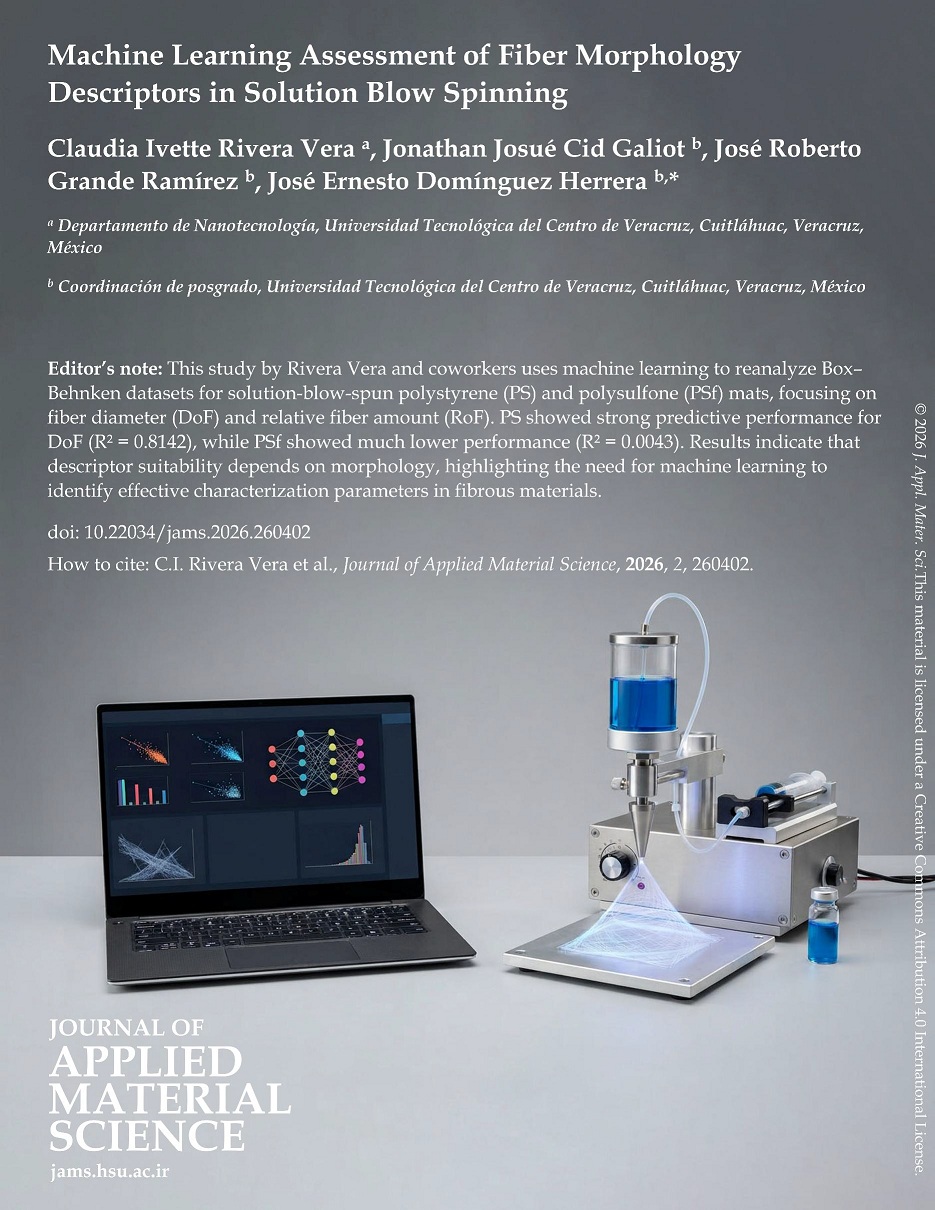
Machine Learning Assessment of Fiber Morphology Descriptors in Solution Blow Spinning

Document Type : Original Article

Authors
1 Departamento de Nanotecnología, Universidad Tecnológica del Centro de Veracruz, Cuitláhuac, Veracruz, México
2 Coordinación de posgrado, Universidad Tecnológica del Centro de Veracruz, Cuitláhuac, Veracruz, México
Abstract
Machine-learning-assisted reanalysis of two previously published Box–Behnken datasets for solution-blow-spun (SBS) polystyrene (PS) and polysulfone (PSf) mats is presented. The analysis focused on fiber diameter (DoF) and the relative amount of fibers (RoF). Regression models were trained using coded processing variables and evaluated by 5-fold cross-validation. For PS, whose morphology was predominantly fibrous, DoF showed the strongest predictive performance; linear regression achieved a coefficient of determination (R²) of 0.8142, a root mean square error (RMSE) of 142.45 nm, and a mean absolute error (MAE) of 91.32 nm. In contrast, PSf mats, characterized by bead-on-string morphology, showed substantially lower predictive performance for DoF and RoF, with mean DoF reaching an R² of only 0.0043. These findings indicate that descriptor suitability depends on the structural regime of SBS materials. Fiber diameter is an informative characterization parameter when continuous fibers dominate the architecture but becomes insufficient when bead-related features contribute substantially to the morphology. Machine learning can therefore complement conventional morphological characterization by helping identify which descriptors most effectively represent processing–structure relationships in solution-blow-spun fibrous materials.
Keywords

Volume 2, Issue 4
in progress
Autumn 2026 Article ID:260402

  • Receive Date 25 August 2026
  • Revise Date 12 September 2026
  • Accept Date 18 September 2026